Learning & study skills · MyHLC guides
A weekly homework plan your student can actually use
Make one list of deadlines, turn each assignment into a small first action, and fit those actions around the week you actually have. Finish each evening by checking what was submitted and choosing tomorrow’s first step. Start with the sample below, then adjust it to your student’s workload and school instructions.
At a glance
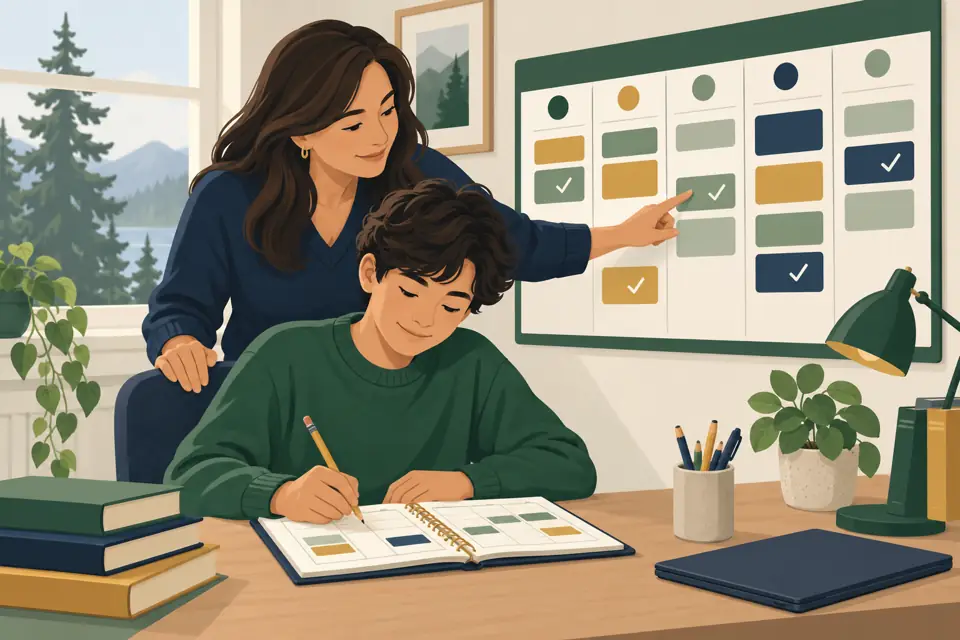
1. Put deadlines in one place
It is Tuesday evening. Your student has a worksheet, a report due Friday and a quiz to prepare for. “Do your homework” does not tell them where to begin.
Set aside about ten minutes to collect the instructions, due dates and materials. Use a notebook, calendar or simple document your student can find independently. A complicated app is optional.
• What is due? Record the assignment and its actual deadline.
• What needs preparation? Include quizzes and longer projects.
• What is unclear? Write a question for the teacher instead of guessing.
Let your student explain the work and help choose the order. Harvard Graduate School of Education’s homework guidance for families describes a supportive planning role for parents while keeping the actual work with the child.
For Shoreline families: Check your school’s current calendar and classroom instructions before choosing work periods. Shoreline School District’s ParentSquare information page explains its family communication tool. School messages and assignment deadlines serve different purposes, so confirm the assignment itself with the teacher or class learning platform.
2. Make the first step small enough to start
Replace a broad task with an action that has a visible finish. “Work on science” becomes “Read the rubric and write three possible report topics.” “Study math” becomes “Try the first three assigned problems and mark the step I cannot explain.”
A small daily reset
| Check | Next action |
|---|---|
| Finished work | Confirm it was submitted. |
| Unclear work | Write one specific question. |
| Tomorrow | Choose the first action and prepare the materials. |
The point is to make starting clearer. It is not to divide every evening into rigid five-minute slots.
Separate finishing work from learning it
An assignment can be complete while an idea is still unclear. Add a short check: close the notes and explain the idea, or try a similar problem without looking at the solution. Then check and correct the answer.
The Institute of Education Sciences recommends spacing learning over time and using quizzes to revisit key content. A practical application is to return to a difficult idea on another day rather than putting all review into the evening before a quiz.
3. Plan around the week you really have
Add activities, travel and family commitments first. Choose a work period your student can realistically use, include breaks, and leave some room for an assignment that takes longer than expected.
Here is an illustrative plan for a short report due Friday. It is one project within a school week, not a complete homework schedule or a required daily workload.
| Day | Next action | Finished when… |
|---|---|---|
| Mon | Read the rubric and choose a topic. | The topic and requirements are written down. |
| Tue | Gather notes and record sources. | Each useful fact has a source attached. |
| Wed | Write a first draft. | Each required section has a starting version. |
| Thu | Compare the draft with the rubric and revise. | Missing parts are addressed and the file is ready. |
| Fri | Submit by the teacher’s deadline. | The submission is confirmed. |
Move the drafting earlier if Wednesday is busy. Check the exact submission time; “due Friday” does not necessarily mean Friday evening.
Use estimates as information
Ask, “How long do you think this first step will take?” Compare the estimate with what happened. If finding sources takes longer than expected, reduce another planned task or ask for guidance. A missed estimate is a reason to adjust the plan, not a punishment.
4. Finish with a two-minute reset
Before closing the laptop or packing the bag, try this short routine. Two minutes is a suggested starting point, not a rule.
Done for today. Ready for tomorrow.
01 · Check Mark finished work and confirm it was submitted.
02 · Name Write the exact question that still needs help.
03 · Choose Pick one clear first action for tomorrow.
04 · Prepare Pack materials or save files where you can find them.
A younger student may need an adult alongside them. An older student can lead the reset and ask for help with the part that remains unclear.
5. Adjust the plan when it keeps breaking down
Look for the repeating obstacle before adding more study time.
• Work gets forgotten: simplify the deadline list and check submission steps.
• One subject takes much longer: bring a recent example to the teacher and identify the skill causing difficulty.
• Starting is the problem: make the first action smaller and prepare the materials together.
• The workload does not fit: record what was attempted and ask the teacher about priorities.
For planning and organization support, explore study skills tutoring in Shoreline. If the difficulty is understanding the work, math tutoring or writing support may be a more relevant conversation. MyHLC also offers live online tutoring for Washington students.
Common questions
Should a parent make the whole plan?
Build the first version together. Let the student explain the assignments, choose a sensible order and identify what they need. Offer more guidance for younger students, then reduce reminders as the routine becomes familiar.
How long should homework take each day?
There is no single time limit that fits every grade, assignment or student. Ask the teacher about expected workload. If homework regularly takes much longer, record the task, time spent and sticking point so you can discuss specifics.
What if an evening does not go to plan?
Choose the most urgent realistic action and move the remaining steps. If a deadline is at risk, contact the teacher early. Keep one difficult evening from turning into an unrealistic catch-up schedule.
Does this replace school support or accommodations?
No. Use the plan alongside the student’s school instructions and any existing support plan. Ask the school team about individual needs or accommodations. Tutoring and planning advice do not replace those arrangements.
Sources & further reading
1. Institute of Education Sciences: Organizing Instruction and Study to Improve Student Learning Research-based recommendations on spacing, retrieval and reviewing learning.
2. Harvard Graduate School of Education: Homework Help for Reluctant Children Practical guidance on a parent’s supportive role in planning homework.
3. Shoreline School District: ParentSquare Official local information about school-family communication.
Sources checked September 13, 2026. The weekly schedule and reset routine are illustrative suggestions, not research-tested protocols.
Explore more guides · Review a practice test
About this guide
Prepared for MyHLC Tutoring with AI assistance. Examples and diagrams are original learning illustrations. Follow the teacher’s instructions and any individual school support plan.
What to do next
Choose one step from this guide and try it with a recent assignment. If the difficulty continues, bring that example to the teacher or discuss tutoring with MyHLC in Shoreline or online across Washington.
Explore more guides · Study skills support · Online tutoring